
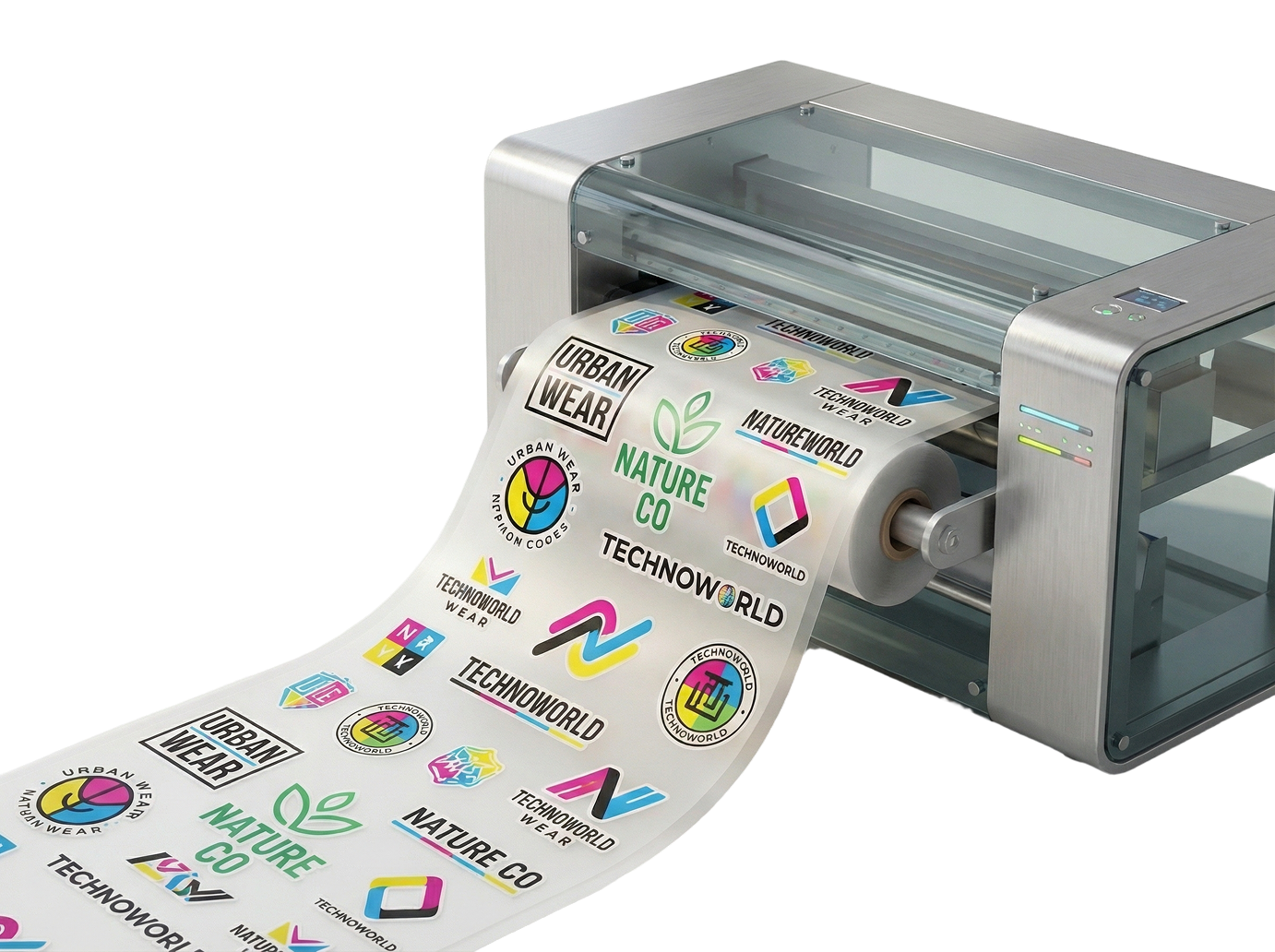
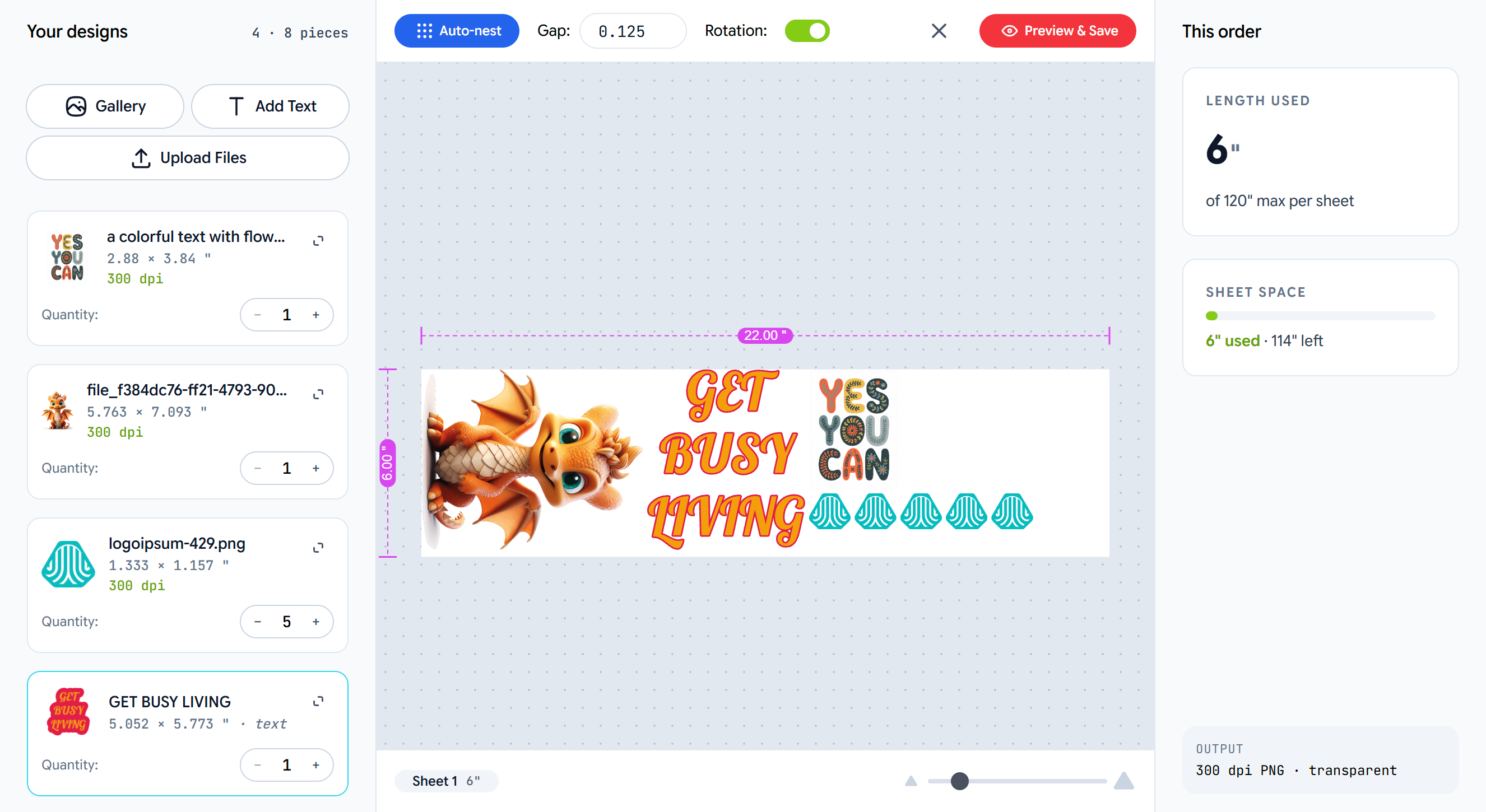
A gang sheet is one length of transfer film carrying many unrelated designs, packed as tightly as they will go. Shops sell it by the length used. The hard part has never been printing it, it has been the hour spent nesting someone else's logos in Photoshop, and the emails about the one file that came in at 96 dpi.
What follows is the running builder, not a picture of one. Drop in a PNG, set a size and a quantity, and watch the sheet pack itself and the length move. Nothing to install and no signup.
Seven things the builder does, and what each one is worth to a shop that presses transfers all day.
| What you get | How | Why it works |
|---|---|---|
| Bigger orders | The free length indicator | The summary shows how much of the film the customer has already paid for but not filled. Pieces added there cost them nothing extra, so they add more. |
| Fewer support emails | A resolution check that names the fix | Artwork below your DPI floor is not just rejected. The builder tells the customer the largest size that would pass, so they solve it themselves instead of emailing you. |
| No bad files at the press | Server-side nest validation | The layout is validated on our servers before checkout, so a customer who nudges a piece cannot push two transfers closer than your cutting gap. |
| Fewer reprints | Crop keeps the print scale | When a customer crops their artwork the piece gets smaller rather than the pixels getting stretched, so a design that passed your floor still passes after editing. |
| No fuzzy type complaints | Text prints as vector | Text added in the builder goes into the PDF as vector glyphs, not as a rasterized image, so it stays sharp at any size on the sheet. |
| Higher value jobs, no extra work | Keyline outlines and halftone | Customers can add a white keyline for dark garments, or screen a piece into halftone dots, without a design round trip through your inbox. |
| Predictable cost | $0.10 per print file | No subscription, no commission, and no fee tied to what you charged for the sheet. A $15 sheet and a $300 sheet cost you the same to process. |
Gang sheets are billed by length, and length is bought in whole increments. A customer whose designs pack into 11.4 inches is paying for 12, and the last half inch of film is going in the bin empty. The builder shows them that empty space and tells them it is already paid for.
That is not a persuasion technique, it is just true, and it is the difference between a customer who orders what they came for and one who adds two more logos because the film is there. No competing app we looked at markets this.
To see the arithmetic on a job of your own, the gang sheet length calculator packs a list of transfers across your film and returns the billed length. It is also the quickest way to see how much an 11 inch front costs you against a 10.9 inch one.
Every dedicated gang sheet app on the Shopify App Store charges a percentage of the sale. Print.App charges for the file it renders, which is the work actually performed.
Published charging models, side by side.
| App | What it charges | Fee ceiling | Track record |
|---|---|---|---|
|
Gang Sheet Builder
by Antigro
|
Free to install, then 5% for the print-ready file | None published | 5.0 stars from 37 reviews, listed since January 2024 |
|
Build a Gang Sheet
by Drip Apps
|
Free to install, then 5% per gang sheet | $12 per order | 4.2 stars from 41 reviews, listed since July 2023 |
|
Print.App
Gang Sheet Builder
|
$0.10 per print file, after 100 free each month | Not applicable, the fee is not tied to your price | New in the category |
Competitor figures are taken from their own App Store listings as of September 2026: Antigro listing on the Shopify App Store and Build a Gang Sheet listing on the Shopify App Store . Other apps in this category publish commissions between 3% and 4%. Percentages and caps change, so check the current listing before deciding. No feature claims are made about these apps here; read their listings for that.
Take a shop selling 500 gang sheets a month at an average of $30, which is $15,000 of gang sheet sales:
And at 100 sheets a month, a shop starting out pays $150 on a 5% app and nothing on Print.App, because 100 files a month are free. The percentage grows with the price you charge; our fee grows with the number of files you render, which is the only thing our servers actually do.
Both are the same design with one setting changed, so you can run one product each way and see which your customers prefer.
The full setup walkthrough, every setting and its default, and the pricing recipes are in the Gang Sheet Builder documentation.
Install free, set your film once, and stop opening Photoshop for other people's logos.

A gang sheet is one length of transfer film carrying many unrelated designs, packed as tightly as they will go, and sold by the length of film used. A gang sheet builder lets your customers fill that film themselves on your store: they upload their designs, set a size and quantity for each, and the software packs the sheet and reports the length so your product page can price it.
Print.App charges $0.10 per print file after 100 free downloads each month. There is no subscription and no commission. The dedicated gang sheet apps on the Shopify App Store charge between 3% and 5% of the sale instead, so at 500 sheets a month averaging $30 they cost around $750 where Print.App costs $40.
Whatever you run. Film width, maximum sheet length, minimum billable length and the gap between pieces are all settings on the design. The defaults match a common 22 inch DTF setup at 120 inches maximum with a 0.125 inch gap, so for many shops the setup is a quick check rather than a configuration job.
The builder measures the film and your store sets the rate. With Print Options you get length tiers, setup fees and server-side verification, and the price moves live as the customer adds pieces. Without it, the builder writes the billable length into your theme quantity input and your existing per-inch or per-foot pricing takes over.
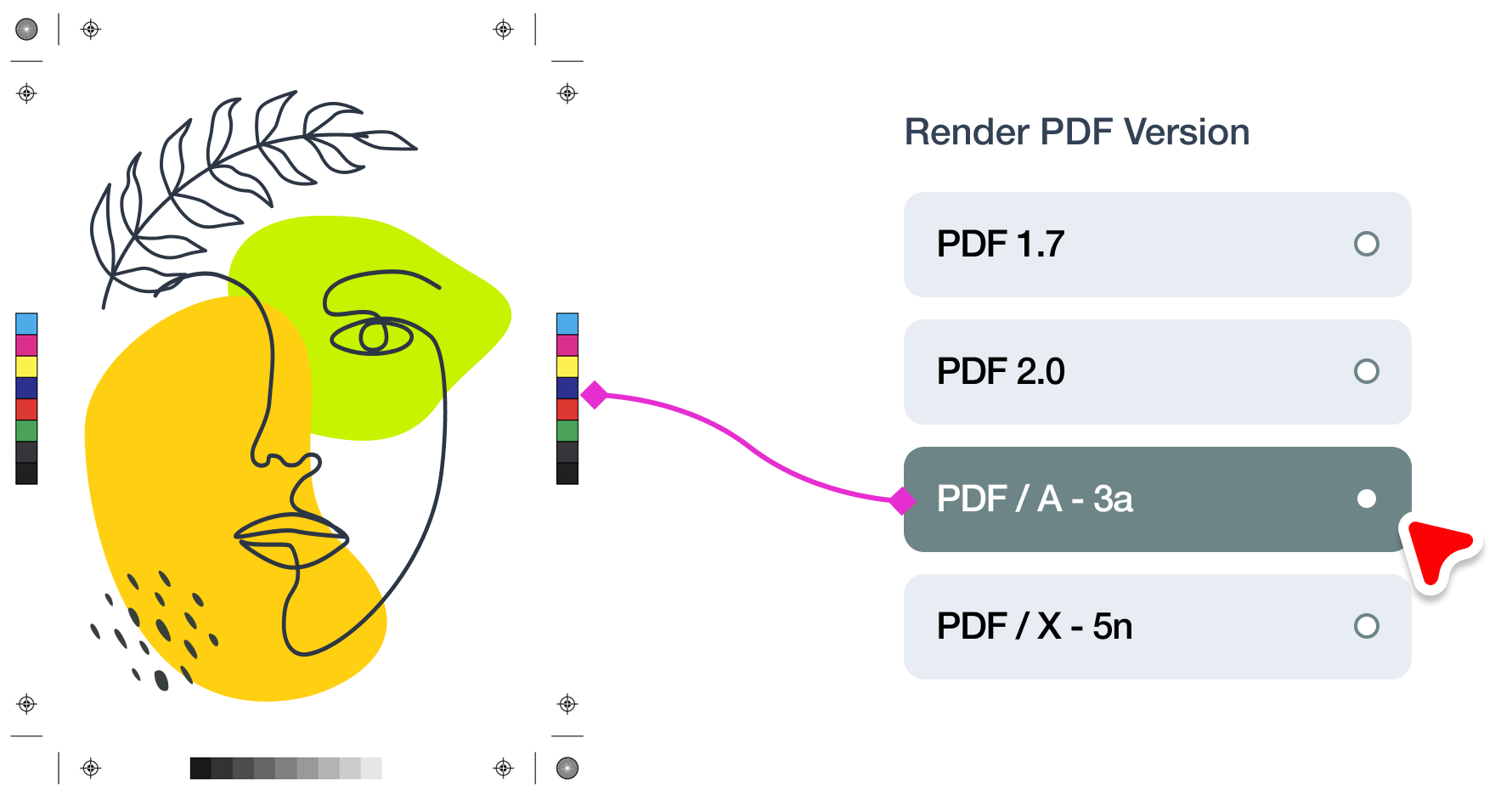
A PDF sized to your film width by the billed length, with a transparent background, every design placed from its original file at native resolution, and text and SVG graphics as vectors. The same render is available as a 300 dpi PNG with alpha, which is what most DTF printers take.
It continues onto a second sheet. The customer sees the sheets as tabs, the print file has one page per sheet, and the billable total is the sum across them.
Yes. The same design has a second mode where the customer sets a print size and copy count per design and pays by print area with copy breaks, and the nesting happens behind the scenes. The customer never sees a sheet, but you still get a packed, print-ready file.
Yes. Print.App installs into Shopify, WooCommerce, Odoo, Shopware, PrestaShop and OpenCart, and there is an API and editor SDK for a custom storefront. The gang sheet builder is the same on all of them.