
Web-to-print, also written web2print and abbreviated W2P, is the part of a print business that lets a customer configure and personalize a product themselves, online, and submit artwork that is genuinely ready to print. It covers the design editor your customer sees, the templates and constraints you set behind it, and the file that lands in your production queue at the end.
The reason it matters is not the editor. It is what the editor removes. Most print shops lose hours per order to a loop that goes: customer emails a file, the file is the wrong size or RGB or missing bleed, someone opens it in Photoshop, someone emails back a proof, the customer changes their mind. Web-to-print moves that loop to the point of sale, where the customer resolves it themselves against rules you defined once.
Search for web-to-print software and you will find two different products sold under the same name. Knowing which one you need saves a lot of demos.
Print.App is the second kind. If you are weighing both, our comparison of web-to-print software lists the main options of each kind with their published prices.
Print.App sits between your storefront and your press. It does not replace your shop, your checkout, or your production system. A customer opens a product on your store, designs it in the browser, and adds it to the cart as they would anything else. When the order is placed you get the order from your normal e-commerce admin, and the print file from Print.App, rendered to the specification you attached to that design template.
The editor is the part your customers judge you on, and the print file is the part your press judges you on. A web-to-print tool has to get both right.
The full list is on the web-to-print editor features page.
Anything a customer personalizes and you print. Print.App shops sell business cards, flyers and stationery, custom apparel, DTF gang sheets and sticker sheets, calendars, booklets and funeral programmes, banners and signage, and repeat patterns for wrapping paper and textiles. The use cases page walks through each.
Prices in this category are hard to compare because vendors charge in different ways, and the way they charge matters more than the headline number:
The side-by-side cost comparison works the numbers through at 500 personalized items a month, and pricing has the full rate card.
Most of this category demos well and fails on the details that only matter once real jobs go through it. The questions worth asking:
Print.App answers those with vector PDF output, 27 built-in ICC profiles, usage-based pricing with a permanent free quota, native integrations for 6 store platforms, and an editor built to work on a phone.
A leading hosted e-commerce platform that lets businesses of any size set up and manage an online store, with a deep ecosystem of themes, apps and integrations.
Web-to-print for Shopify →The most widely used store platform for WordPress. Print.App installs as a plugin and adds a full product designer to any WooCommerce product.
Web-to-print for WooCommerce →An open-source business suite whose eCommerce app runs storefront, inventory and accounting in one system. Print.App installs as an Odoo module for versions 17 and 18.
Web-to-print for Odoo →The leading eCommerce platform of the German-speaking market, home to much of the world's online printing. Print.App installs as a Shopware 6 app for versions 6.6 and 6.7, on self-hosted Shopware and Shopware PaaS.
Web-to-print for Shopware →An open-source shopping cart built on PHP, with an active community producing themes and modules. Print.App ships as a PrestaShop module.
Web-to-print for PrestaShop →A lightweight open-source cart known for its simplicity and extensive language translations. Print.App installs as an OpenCart extension.
Web-to-print for OpenCart →That is the real editor above, not a video. Design something, then look at what it would send to your press.

Web-to-print, also spelled web2print and abbreviated W2P, lets a customer personalize a print product in their browser, on your store, and submit a print-ready file with the order. It replaces the "email us your artwork" step, along with the back-and-forth that follows it.
Yes. Web-to-print, web2print, web 2 print and W2P all name the same thing. Web2print is the more common spelling in Germany and the Netherlands, web-to-print in the US and UK.
A product customizer is the design editor a customer uses on the product page. Web-to-print software is the editor plus everything a print shop needs behind it: templates with trim and bleed, colour management, and a print-ready file at the end. Print.App is both. Many customizer apps stop at a preview image, which looks the same on screen and is not something a press can run.
No. Print.App installs into the store you already run on Shopify, WooCommerce, Odoo, Shopware, PrestaShop and OpenCart. It adds a design editor to the products you choose and leaves everything else, including checkout, alone.
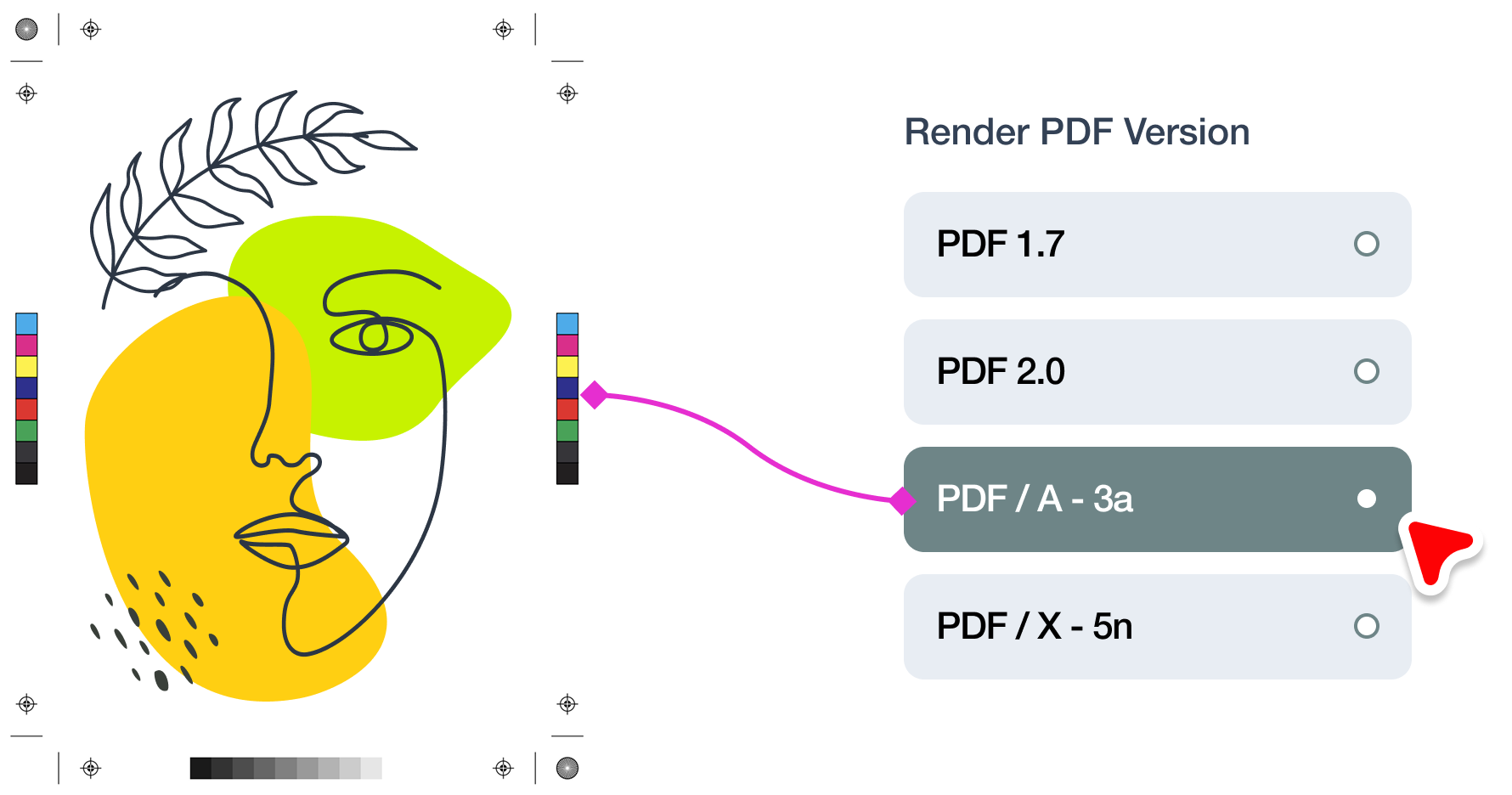
A print-ready file in the format you configure: PDF, PNG, JPEG or TIFF. You control bleed, resolution, color profile and cut lines per design template, so what arrives matches what your press expects.
Yes. Print.App ships 27 ICC profiles covering ISO Coated, PSO, GRACoL, SWOP, FOGRA and Japan Color, and converts RGB to CMYK at render time using the profile you assign. Customers can soft-proof in the browser before ordering. Pantone and HKS spot colors keep their names in the PDF.
Print.App is free to install and the first 100 print file downloads each month are free, permanently, so a small shop can run real orders without paying. The Odoo module and the Shopware app are open source under LGPL-3. The editor and the PDF rendering run as a hosted service, which is what keeps them updated without you maintaining a server.
Usage-based. The first 100 print file downloads each month are free, then $0.10 per download. Storage is 1GB free per month, then $0.05 per 100MB. Designs and projects are unlimited. There is no subscription and no commission on your orders.
There is no trial to expire. The free monthly quota is permanent and resets on the first of each month, so you can run real orders through it before you pay anything.
No. There is no per-order fee, no commission and no percentage of revenue, on any plan. You pay $0.10 when you download a print file and nothing else, so a $12 mug and a $1,200 signage job cost exactly the same to process. Order-based fees scale with your sales rather than with the work actually done, and we would rather charge for the work we perform and leave your margin where it was earned.


